The Key to Social Selling is a Healthy Content Mix
When in doubt, simplify.
This has been my personal catchphrase for ~6 months. It's my version of Marie Forleo's saying "Everything Is Figureout-able."
The deeper we get into our work, the harder it is to simplify it. I can get overwhelmed by the nuance, I feel, is important.
Salespeople struggle with this, too.
When they chat with prospects, they're quick to jump to features and benefits.
Or explaining use cases before they understand their buyer's use case.
I'll give them some leeway, though.
Salespeople are paid to see possibilities and solve problems. They just tend to get ahead of themselves and solve problems their prospects don't have.
If that sounds familiar, it's because we do the same thing with content.
The best salespeople I've worked with do three things so they don't overcomplicate it:
Listen to the problems clients are faced with.
Ask questions to confirm they have the right solution.
Pair giving the client decision-making space with active follow up.
Social media marketers and business owners do this all the time and overcomplicate social selling.
The fix for salespeople seems simple: 3 steps in a Zoom call? Easy.
But social selling feels harder because it’s personal, especially if you’re a small business owner running their own marketing.
It's your name, your face, and your reputation on display.
The bad news: You can't avoid selling and expect sales...
One lesson I learned early in my career was you've gotta put the reps in before you expect to see results.
It sounds like a platitude, but it's a tough pill to swallow.
You can read the full story of why that lesson stayed with me on LinkedIn.
Selling on social media (especially on Instagram) asks business owners to be incredibly vulnerable.
And that makes 'putting in the reps' even harder. No wonder some people don't talk about their services online!
I know this isn’t the advice people want, but it’s what works...
I'm gonna hold your hand as I say this:

You gotta put in the reps.
If you want social media to bring you leads that pay you money, you have to sell on social media.
It's uncomfortable, but it's part of running a business online.
(And no, I don't mean adding BUY NOW to every caption.)
The good news: There's a less scary way to sell online
The key to social selling (without feelinglike you're hawking your wares) is to use a diversified content mix.
Every post isn't meant to convert.
Some posts build trust. Others build familiarity. Sometimes, you just need to remind people you exist.
Many of my clients hate the feeling of being "salesy".
They'd rather use their platforms to talk about their subject matter expertise instead of "convincing people to purchase their thing".
I've even heard people say "if they need me, they can reach out".
Look, I get it.
I'm revising Hot Olive's content mix because my strategy didn't follow the advice I give clients.
This mentality of "I don't need to ask for the sale" creates the highs and lows in business.
If you don't sell until you're desperate, when you start the energy is weird.
Then, you're out of practice for how to talk about your offers. When no one buys, it confirms you shouldn't explicitly sell anymore.
This is the wrong feedback loop to listen to.
Do this instead:
Talk about your offers 25% of the time.
Rotate between hard, soft, and subtle sells.
Highlight different offers every quarter.
Let's dig deeper into why these paths can help:
Talk about your offers 25% of the time.
Audiences tune out if you do nothing but sell. If you never sell (or do so randomly), they're never aware you can (or want to) solve their problem.
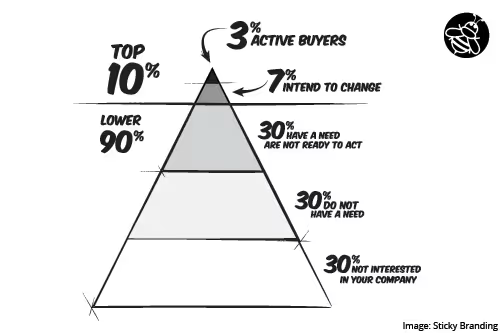
According to the book Breakthrough Advertising, only 3% of the marketplace is actively looking to purchase.
This means 97% of your market isn't ready to buy -- and that's okay.
But they are learning, paying attention, and figuring out who they trust.
So when the timing is right, they come to you because your offer feels like the obvious next step.
If you’re selling consistently, you’re present when they’re ready and LONG before they’ve researched other options.
Rotate between hard, soft, and subtle sells.
Here's a quick refresher on the differences between these styles.
Hard sells: BUY NOW or JOIN THE WAITLIST.
Soft sells: I can help - here's how. (I use these a lot.)
Subtle sells: The kind most people don’t even realize are happening.
Did you catch where I did this earlier in the email?
I talked about my clients problems and the advice I give.
It reinforces that I'm a professional. That people pay me to solve these problems… and you could, too.
That’s why I like subtle selling. It builds familiarity and trust in the background.
Switching between these styles gives you flexibility. Buyers respond differently based on their timeline, personality, and pain points. Your content meets them where they are.
Highlight different (aspects of) offers every quarter.
If you have one offer, spotlight different aspects of it throughout the year.
A group coaching program, for example, might emphasize the DIY resources in Q1 and the live coaching calls in Q2.
If you have multiple offers, rotating the focus quarterly prevents over-saturation. It gives your content a fresh lift, shows the range of ways you can help, and opens the door to clients who may not want one offer, but are desperate for another.
How to become a great social salesperson
At its core, your job isn't to convince someone to buy what you're selling. (That's an icky salesperson.)
Your job is to give your audience context. So when their budget, needs, and timing align, your offer makes sense.
How do you give them context?
You add sales-focused content into your existing content calendar.
No countdown clock needed.

When sales content lives inside a healthy content mix, it:
educates the audience
gives context to the offer
prevents the audience from getting cold
speaks to audiences at different parts of the sales cycle
Social media and content marketers who diversify their content mix get better results than those who only hard sell or never talk about their offers.
And if you can pair that with the fundamentals of good selling?
You’re wayy ahead of most people online.
Selling doesn’t have to be a launch.
It doesn’t have to feel icky.
It doesn’t even need to generate hundreds to “count.”
Consistent diversified selling compounds. Instead of chasing transactions, you’re building trust in your brand.
And that's what drives sales.
So here's a soft-ish sell of my own:
How can I help with your marketing?
Go promote yourself... You're worth it!
Other Reading
FAQs
-
For the most part, yes.
The good news is that by varying your selling style to make buying from you feel obvious.
-
My rule of thumb is about 1/4th of the time, or 25%.
Within that, I recommend rotating between hard, soft, and subtle sells so your audience stays warm without tuning you out.
-
Before you post about an offer, start by
Listening to the problems clients are faced with.
Asking questions to your audience to confirm you can solve their biggest problem.
Once you deeply understand your audience, then you can start planning your sales content.
Talk about your offers 25% of the time.
Rotate between hard, soft, and subtle sells.
Highlight different offers every quarter.
-
Hard: Direct CTAs (Buy now, Join, Book)
Soft: Explaining how you help and inviting conversation
Subtle: Demonstrating expertise and problem-solving without an explicit CTA
-
For sure.
Ongoing, diversified sales content compounds over time. Instead of chasing spikes, you build trust so buyers come to you when they’re in the market for your exact offers.
