Welcome to 2026 Planning Season!
Maybe you mapped out your goals last fall, or maybe you just cracked open your shiny new planner this week.
Either way, you’re in good company.
This week, I co-hosted a LinkedIn Live with Social Media Club Global to talk about strategic goal-setting and content planning.
Today, I’m breaking down the highlights for anyone rethinking what their “fresh start” actually looks like.
On The Menu For This Week’s Tapas:
[RECORDING] 🎥 Goal Planning Convo with Social Media Club
[TIP] 🏋🏽♀️ ACTIONS > Outcomes
[BOOK] 📚 The 12 Week Year
Want a quicker read? Skip to Step 4.
Step 1: Reflection + Intention.
My father-in-law had some incredible wisdom for his kids and I have found myself unintentionally quoting it:
“You gotta decide who you are and who you wanna be.”
Chances are you've already reflected on your 2025 wins and losses.
But here's what I think when thinking about what we did and didn't do last year: Not all goals deserve a second chance. Some goals are just bad fits.
If it doesn’t align with your future self (who you wanna be), toss it.
This is the way I graded my 2025 efforts:
Score each department effort as -1 (hurt), 0 (neutral), or 1 (helped).
Anything scoring -1? Make notes on how to improve or toss it.
Anything scoring 1? Keep it consistent or build it.
Anything scoring 0? Decide if it deserves improvement or maintenance.
Step 2: Create a single vision.
Vision boarding. Themes. Words of the Year. These can be fluff. But when done well, they keep your focus front and center.
One of my favorite examples on how this is done well is from a previous client.
Their theme was Growth by Partnerships.
Every smaller goal, every action had to support that, from social strategy to content. If it didn’t, it got scrapped.
I did their digital marketing. We focused on user-generated content and working with creators. We eclipsed almost every previous partnership effort and won tons of visibility.
This is the power of everyone supporting the same goal.
Step 3: SMART goals suck. Structure them with EOS.
Yes, SMART goals are foundational:
Specific
Measurable
Achievable
Relevant
Time-bound
But they’re not enough on their own.
However, when we pair them with the context of an Entrepreneurial Operating System (EOS), they can become super powerful.
Here's how the EOS works: Your life is a jar.
You add the 3 biggest rocks in your life (big, audacious goals).
Then, place the medium rocks (supporting goals or tactics).
Finally, you fill the spaces with sand (day-to-day tasks).
You have to fill the jar in order, or else nothing will fit properly.
(Anyone else know this to be true from packing a suitcase?)
Everything in your life must support the 3 biggest goals. If it doesn't support those 3, they don't go in the jar.
Now, there's no room for random goals that don't move the needle.
Step 4: Actions > Outcomes. Every time.
Buckle up, it's time for my soapbox.
Outcome-based goals set you up to FAIL.
Why Outcomes Are TRASH Goals
You can’t control the result. Algorithms shift daily (and twice on Sundays). Audiences are fickle and unpredictable. Tying your goal to an outcome is gambling.
Your morale tanks. If an outcome doesn’t happen, it's a personal failure... even when you did everything right.
You don’t build anything. You leave with no system, no habit, no framework for how to win next time. All you have is a number you didn't hit (and you don't know why).
BAD GOAL EXAMPLE:
Grow account by 1,200 new followers by March 31 by publishing consistent content and monitoring growth weekly.
At first glance, this looks SMART: specific, measurable, time-bound.
But it’s TRASH because it’s tied to an outcome, not an action. You cannot control how many people follow you. Even the “actions” of this goal, publishing and monitoring, are reactive and vague, at best.
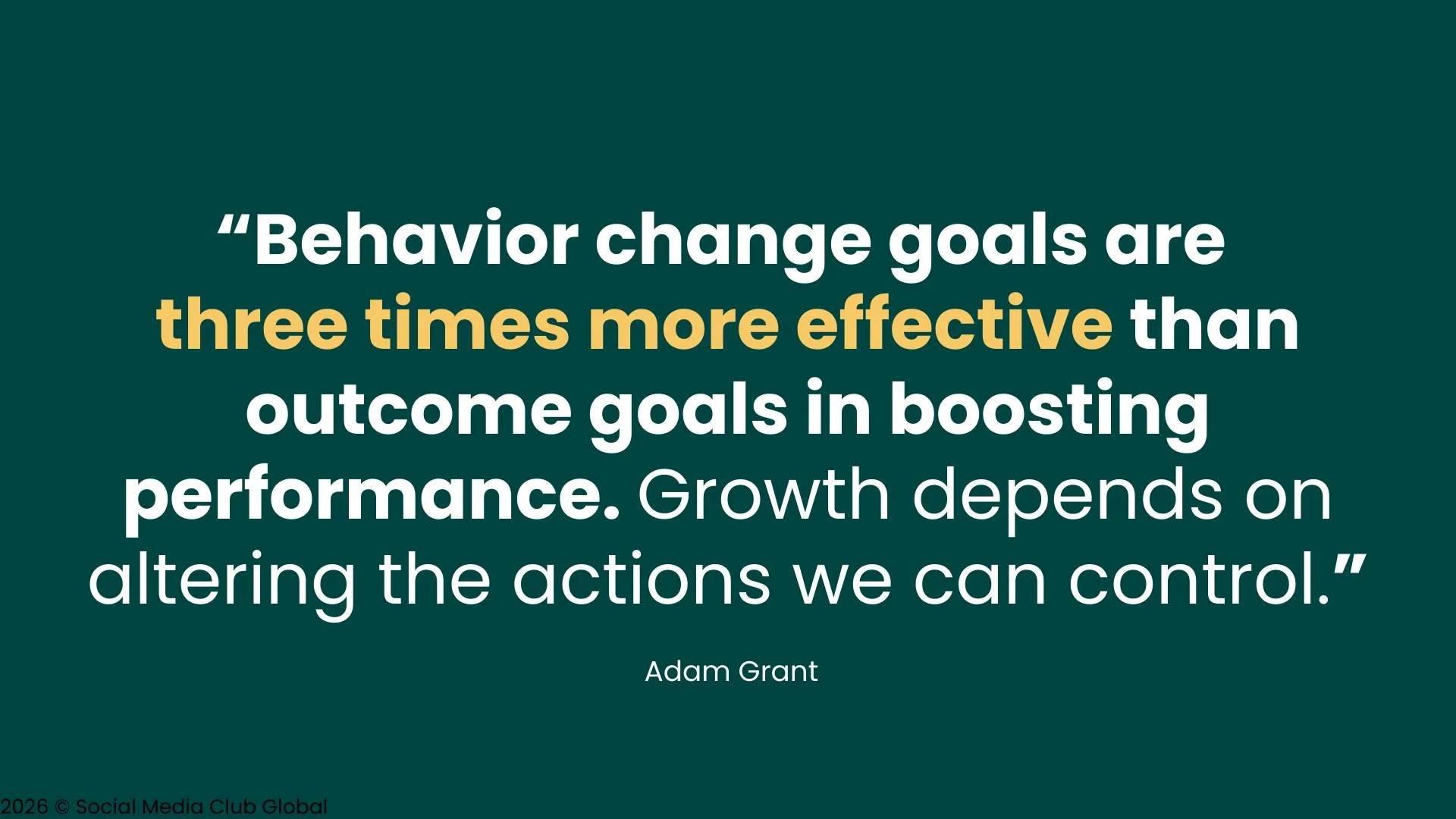
Set goals around actions, not outcomes.
Improve the actions you take by building better habits.
Need a second source? Just ask James Clear or Adam Grant.
BETTER GOAL EXAMPLE:
For the next 12 weeks, comment on posts and start DM conversations with 10 new, right-fit accounts each week. Publish 3 benefit- or pain-point-focused posts per week, with a weekly review of engagement metrics to refine topics and formats.
Did you notice?
No follower goal
All actions are in YOUR control
Each action supports audience engagement, analysis, and content flexibility
With the above goal, you're actively engaging with the right people with content they value. The follow will come.
Ask yourself:
What's an outcome I want?
What actions could impact that outcome?
Which habits or systems would make those actions easier and more consistent?
Here's a few examples of mapping outcomes to actions and habits:
More followers? → Engage with 10 new accounts weekly → Block time on calendar for engagement
More reach? → Test 3 hooks each month → Monthly meeting to review post performance
Grow your list? → Promote your newsletter in 3 places each week → Schedule cross-promotion
Better engagement? → Reply to every comment with a thoughtful response within 24 hours → Block 15 mins to respond daily (different than engaging with new accounts)
If your current goals rely on the algorithm, virality, or “getting discovered,” it’s back to the drawing board with those goals.
Step 5: Plan for HARD Mode.
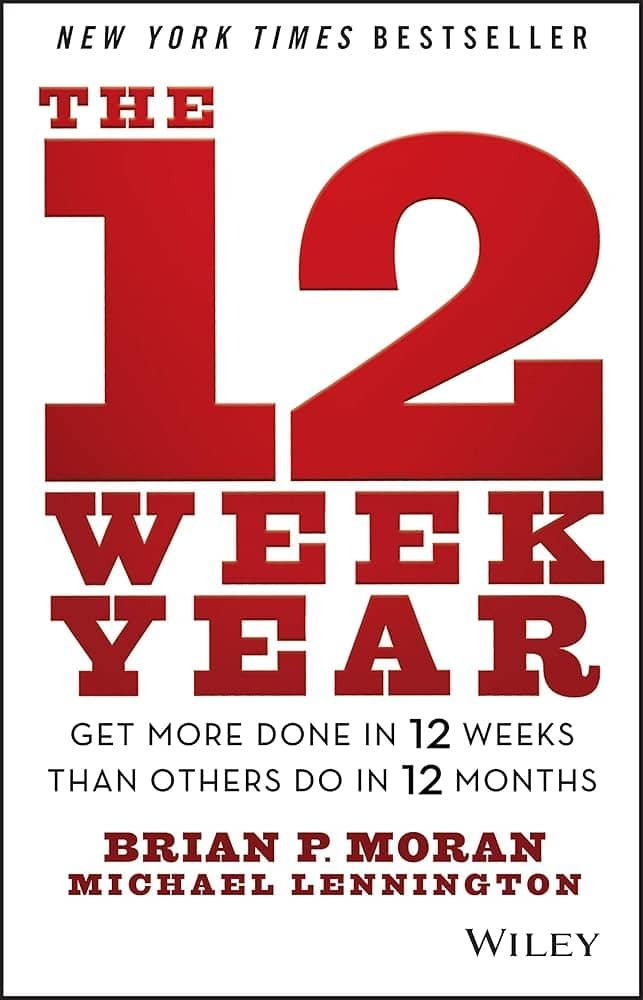
I'm reading the 12 Week Year again.
What's standing out to me upon re-read is what I and most people miss with planning:
You’re planning for your busiest weeks, not best-case weeks.
You must have an idea of the compromises you'll face with a new habit-change before you face it.
Knowing what you're signing up for before you face it helps you "weather the storm."
Here's how you can plan for the worst before it hits:
Limit yourself to 3 goals or habit shifts
Build in margin (like 25% to budget for chaos)
Assume things will change, and have a plan to ground you
In content planning, I do this by creating "contingency content" WAY before I need it.
Examples of contingency content:
A product failure comes up: Do you respond to comments, but not post? Do you post and refer all comments to DMs?
An emergency weather alert cancels an event: Do you have a post template ready?
Social media unrest means your content isn't landing well: Do you take it down?
And now, a frequently quoted line that's still useful, regardless if it's accurately attributed.
“An ounce of prevention is worth a pound of cure.” – Benjamin Franklin
For my content calendars, we plan for 75% of what we want to post.
This way, we can be nimble and reactive to the remaining 25%.
We can move with speed and confidence knowing that we always have something on the calendar.
Then, we don't have to rely on our creativity or "being in the mood to get on IG Stories". We're good for whatever comes next.
Be real with me, have you ever said something like:
“I can't plan when no one sends me info on time...”
“How far ahead do I actually need to plan for?”
“I don't plan because it never works out anyway."
You’re not alone, and you’re not doing it wrong. You just need a better system and set of habits.
Ready to Get Your Plan in Place?
Here’s how I can help on the marketing front:
DIY: Mastering Content Calendars Self-Paced Email Course — Join the waitlist for 2.0.
DFY: Monthly Content Calendar or Hourly Retainer — Send me a note.
Remember: Focus on what’s yours to own.
