⚔️ A Tale of Two Marketers: Brand vs Performance
I was telling a client last week the difference between Performance and Brand Marketing. I realized I had never written about this in the newsletter. So this week, I'm recapping all the ways I talk about this with clients.
BEWARE: This is a long one.
On The Menu For This Week’s Tapas:
[REFRAME] 💹 Marketing Is Like Playing the Stock Market
[VERSUS] 🥊 Brand vs Performance? (Spoiler: They're Better Together)
[TOOL] 📊 Dashboards are a Performance Marketers Best Friend
There are two main “houses” of marketing:
Performance Marketing
Brand marketing
Most data nerds tend to fall into the performance category, while the storytellers are typically in the brand camp.
…and that is usually where I lose the non-marketers.
So here’s how I explain it to everyone else:
💹 Marketing Is Like Playing the Stock Market
You know how you start investing for retirement when you’re 22 because it takes a very long time for that money to compound?
Then once you’re ready to retire — you’re a millionaire (or so they tell us…)?
Marketing is the same as financial investing in that there are two key ways to get rich: Slow investments (brand) or fast day-trading (performance).
What is Performance Marketing?
Performance is the day trading of marketing.
In day-trading, it doesn’t matter if a stock is stable (or even successful) over time. The only thing that matters is if you can sell it for more than you paid for it.
You can start with $500 of ad budget then tie those same dollars to the amount of revenue you can generate.
CFO and the Sales teams LOVE performance marketers because the return on investment (ROI) is simple: X dollars in, Y dollars out.
Performance marketers are obsessed with:
A/B testing
conversion rate optimization (CRO)
return on ad spend (ROAS)
Performance marketers are scientific by nature.
They love the game of finding out exactly which change led to an increase (or dip) in performance.
They track every action that led to a sale.
They aim to repeat it, so the act of marketing becomes a predictable machine.
They analyze every percentage change looking for an indication of success or failure. Up or down.
Performance goes for short-term conversions to get you dollars NOW.
This is why so many people fall for performance marketing early.
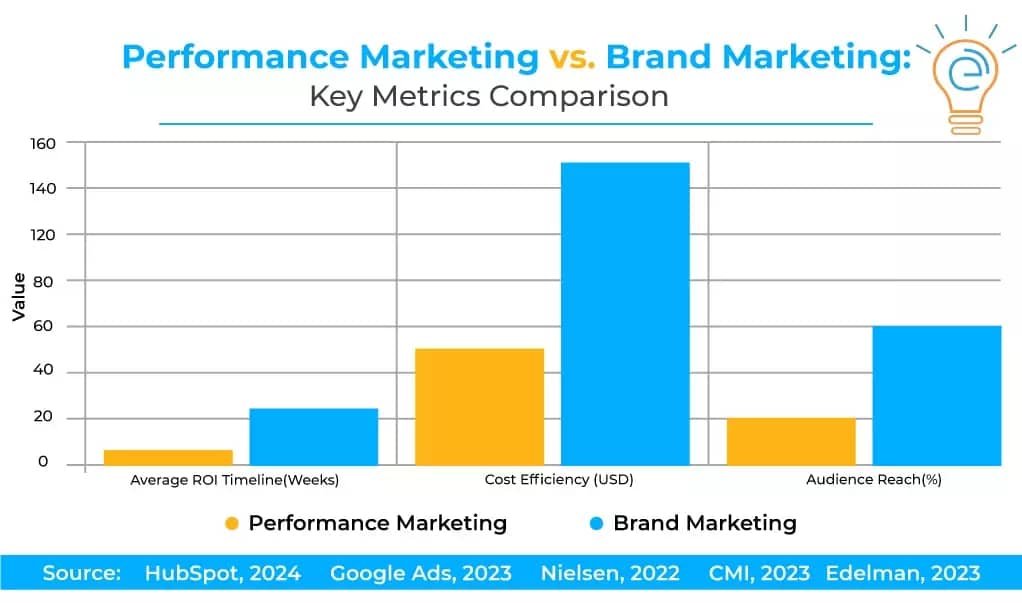
ExnoWeb shows how Performance Marketing takes a fraction of the resources that Brand Marketing takes, but the audience reach % suffers.
By this chart, a reasonable person could say
“Brand takes more time and costs more money! I’m only using Performance Marketing.”
While that would be a reasonable takeaway, it’s not the full story.
What is Brand Marketing?
Brand focuses on the long-term play.
The stronger your brand is, the more effective all performance marketing efforts will be.
Why do brand marketing?
Steady, recession-proof portfolios take time to build.
You can’t start marketing efforts and expect them to pay off immediately.
Brand Marketing relies on solid business strategy, strong consistency, and high-quality output.
In the digital age, brand marketers fell out of fashion because tracking performance like clicks and conversions was so much easier than tracking brand sentiment or word of mouth.
But now as Dead Internet Theory (the idea that we interact with more bots than humans online) is on the rise, I’m seeing a slow retreat from the internet to comfort ourselves with real-life humans.

Brand marketing helps prove that:
We are reliable
We are human
We can be trusted
A great brand with a great reputation can sell itself.
Brand marketing is back, baby.
But performance marketing isn’t going away.
It’s the left hand to brand marketing’s right.
🥊 Brand vs Performance? (Spoiler: They're Better Together)
Here’s how I proved this to my old boss:
I worked at a startup where the CEO was very skeptical about advertising. Every few months they’d say
“We aren’t seeing the ads convert. They must not be working for us. Turn them off so we can see the effect.”
I begrudgingly would turn off all the Facebook Ads we knew performed well. Then, our sales on Amazon would plummet.
During our marketing meeting to recap this “test,” my colleague Jen would turn to me and say
“Coca-Cola still does advertising and everyone on the planet is familiar with that brand…”
What we already knew:
The CEO thought the ads weren't converting because we weren't seeing purchases through our direct e-commerce store.
But our Facebook Ads were keeping our Amazon sales afloat.
If we turned the ads off, all online channels plummeted. Even in channels where we weren't advertising.
Instead, buyers would see the ad and add our product to their Amazon cart.
(Our website prices were higher than Amazon and our fulfillment took longer than 2-days. Of course buyers purchased on Amazon!)
So what did we actually learn during this experiment?
Our ads weren't acting as performance marketing channels (which they typically are), they were instead keeping our brand top-of-mind for the buyers who were the Most Aware.
Brand and performance marketing work best TOGETHER. If you turn one off, both suffer.
📊 Dashboards are a Performance Marketers Best Friend
Performance marketers love a dashboard to see all their combine data.
For social media, it looks like impressions, click thru rate, reactions, and top posts all in one place.
While many Social Media Managers build their own dashboards in Canva or in a PPT deck, there's two tools that can make this a bit more simple:
Databox (Paid)
LookerStudio (included with Google Workspace)
Databox is powerful and *mostly simple. They have an incredible set of resources on their website along with trainings.
If you need a free option, Looker Studio is just as powerful, but is a bit more technical.
For either tool, you’ll need to time block several hours train on the tools, but once you understand them — you’re on your way to becoming a powerful performance marketer.
Don't let anyone tell you to choose.
You can love both: Storytelling and Stats.
